PhD! September 20, 2010
Posted by Malene Charlotte Larsen in Aalborg University, Academic, PhD.14 comments
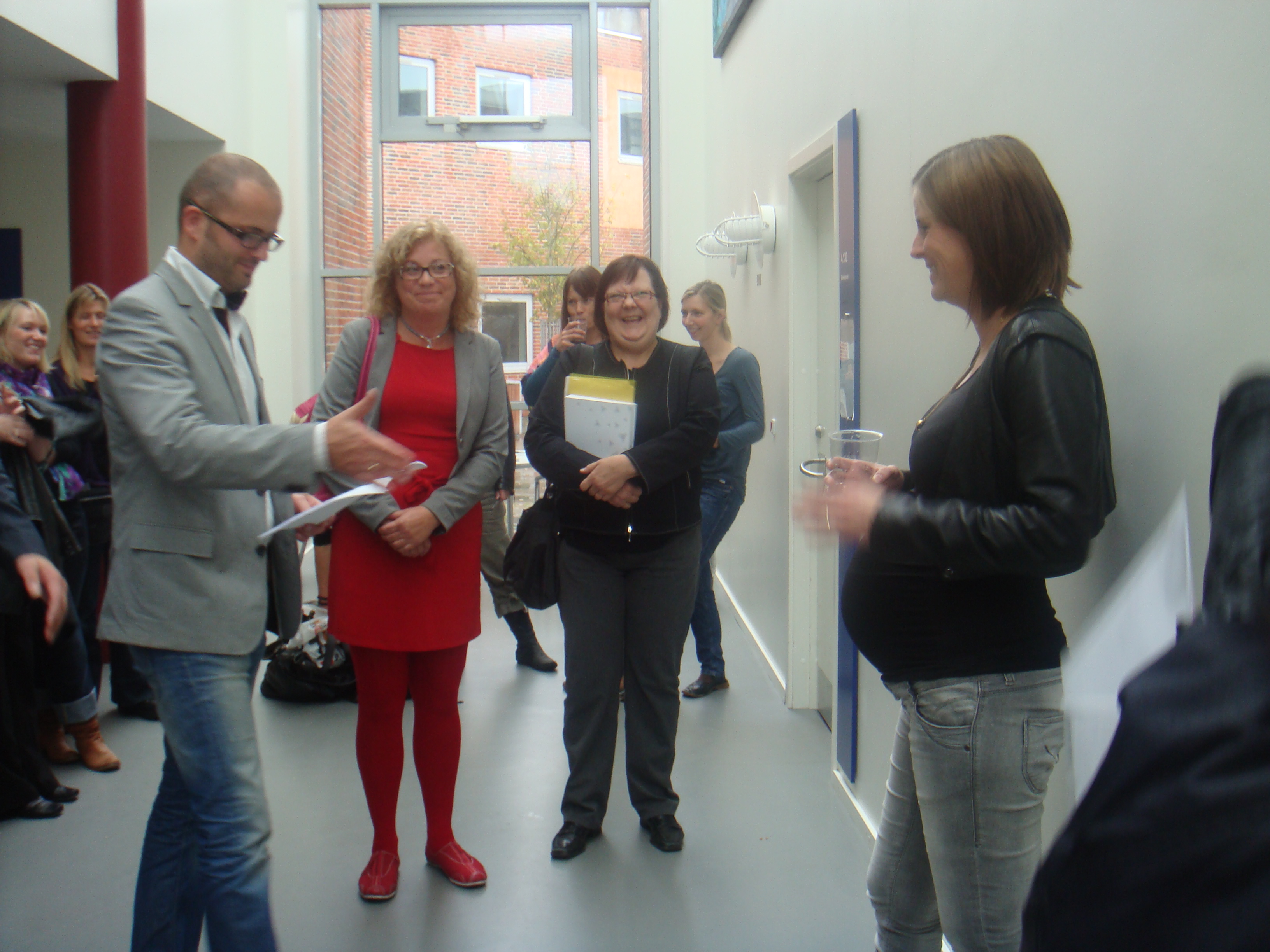
I am happy to announce that I now have a PhD 😀 Friday was the day of my PhD defence and it was a really good experience. Especially, I want to thank the assessment committee, Mikael Vetner, Elza Dunkels and Leena Kuure, for creating a nice atmosphere with relevant questions and a good academic discussion.
Thanks to everyone who helped celebrate me (colleagues, students, friends and family) – I had an amazing day.
The entire defence was videotaped and will be available at Aalborg University’s web page at some point. I will add a link when it’s online!
For the time being, I will focus on my next big project – the birth of my future daughter (I am 38 weeks pregnant). This also means that I am now officially on maternity leave and will probably not be bogging that much.
Thanks to all the readers of My PhD Blog who have followed my academic efforts the past 3,5 years.

PhD defence September 9, 2010
Posted by Malene Charlotte Larsen in Aalborg University, Academic, PhD.3 comments
It’s official! My PhD dissertation has been accepted for defence. The defence will take place next Friday, September 17, at Aalborg University from 9-12.
During the defence I will be giving a 45 minute presentation of my work where after each member of the assessment committee will have 30 minutes to ask me questions.
The assessment committee consists of:
- Associate professor Mikael Vetner, Department of Communication, Aalborg University (head of committee)
- Associate professor Elza Dunkels, Umeå University, Sweden
- Dr Leena Kuure, University of Oulu, Finland
After the defence the Department of Communication will host a reception. Read more about the defence here (in Danish) and sign up for the event on Facebook.
Download the full dissertation here (in Danish).
PhD thesis submitted! :-) August 6, 2010
Posted by Malene Charlotte Larsen in Academic, Dissertation, PhD.17 comments
 After 3,5 years of PhD studies I have finally submitted my thesis to The Faculty of Humanities at Aalborg University. The thesis is entitled “Youth and Online Social Networking: A Nexus Analytic Study of Mediated Actions and Public Discourses” and is 388 pages long.
For several practical reasons, the thesis is (regretfully) written in Danish, but here is a short English summary:
The present PhD thesis investigates Danish children and young people’s use of a relatively recent web-phenomenon: Online social networking. The so-called social network sites (SNSs) are internet based social spaces where users via personalised profiles can list each other as friends and communicate and socialise across time and space. The main purpose of the thesis is to gain an understanding of the meanings SNSs, such as Arto and Facebook, have for young people’s individual and social lives and how they use them as part of everyday life. In order to investigate this, the thesis takes its analytic departure in an extensive amount of various empirical data. The primary data consist of five years of ethnographic engagement (including participatory observation within the field) and a large-scale qualitative questionnaire aimed at investigating the experiences that 12-18 years old Danes have on social network sites. In this way, the thesis encompasses both the level of social actors and the level of discourse. It explores and analyses the central actions young people carry out across social network sites, as well as the ways in which they discursively construct and articulate their concrete use and experiences.
#PhD twittering June 30, 2010
Posted by Malene Charlotte Larsen in Dissertation, PhD, Twitter.9 comments
At the moment I have less than a month left before I absolutely have to turn in my PhD dissertation. On Twitter I am using the hashtag #phd to communicate my ups and downs – and it is comforting to know that there are other people out there in the same position. So if you are a PhD student on Twitter I recommend that you use #PhD in your dissertation related tweets.
Here are some of my latest PhD tweets that nicely illustrate this last phase of dissertation writing:
- Writing a PhD is filled with many ups and downs. Yesterday I was down – today I’m up. Please remind me of this tomorrow! #PhD #dissertation
- Note to self! #PhD RT @TDDissertation #Dissertation Writing Tip # 20: You made it this far for a reason. Have confidence in your writing!
- A must RT from @phdcomics: #worldcup
 vs. #PhD: http://www.phdcomics.com/comics.php?f=1329
- Trying to sum up this part of my analysis on “Youthful emotions in public space” – seems like a never-ending task 🙂 #PhD
- Best #PhD tip of the day: RT @TDDissertation Reward yourself for small writing accomplishments by doing something you enjoy. #dissertation
- Which font should I use for my #PhD thesis? #procrastination
- Yellow post-its overload in office! #PhD
- 🙂 RT @phdcomics ‘A story in file names’ http://www.phdcomics.com/comics.php?f=1323
- Just fell asleep in a Fatboy in my office… #Sundayafternoon #PhD
- Revisiting my motive analysis #PhD #Sundaymorning
- Have ran out of yellow post its #PhD
- Ahh – the joy of copy/pasting from things you’ve already written #PhD
And here are two ‘must-follow’ accounts on Twitter for PhD students:
@phdcomics: http://twitter.com/phdcomics
@TDDissertation: http://twitter.com/TDDissertation
Happy #PhD tweeting! 🙂
Making a Mess with Situational Analysis May 12, 2010
Posted by Malene Charlotte Larsen in Academic, PhD, Talks.17 comments
At the Department of Communication here at Aalborg University we have a doctoral program in Human Centered Communication and Informatics (HCCI) which each Wednesday hosts informal lunch seminars where PhD students can discuss ongoing research, present paper or dissertation drafts etc. Today me and guest from Aarhus School of Business, Annette Agerdal-Hjermind, each gave a presentation under the headline ‘Making a Mess with Situational Analysis’. Annette and I are both using Situational Analysis (Clarke, 2005) in our PhD projects and we wanted to exchange experiences and receive feedback from colleagues.
Annette is working with blogging in an organisational context and gave an interesting presentation on her case, data and how she is planning to use Clarke’s situational maps when coding, mapping and categorising her data. You can learn more from her PhD blog.
The situational maps are exactly the parts of Clarke’s framework I have integrated in my PhD project. Here, I am using Scollon & Scollon’s (2004) Nexus Analysis as a methodological and theoretical framework. As a first step in a Nexus Analysis the Scollons suggest that you make broad-stroke maps of your field and the many discourse cycles that are circulating through the moment of social action you are studying. I think Clarke’s maps are useful tools when engaging in such a task, since the point is to map out “the complex situations of inquiry broadly conceived” (Clarke & Friese, 2007, p. 366). Both Clarke and the Scollons believe that ‘context’ should be understood and treated as something that exists within the siuation of inquiry (and not as mere background). Therefore, I think the two frameworks go well together and the combination has worked for me when trying to sketch out maps of young people’s use of social network sites in Denmark.
You can learn more and see the slides from my presentation here (at the last slide I have included a list of references.):
Science communication competition April 16, 2010
Posted by Malene Charlotte Larsen in Academic, Science communication, Talks.5 comments
Next  week I am participating in a national competition in science communication called ‘Forsker Grand Prix 2010’. The Danish Agency for Science, Technology and Innovation, who is behind the competition, has launched it as an academic version of X Factor or as “Rock ‘n Research”.
We are eight PhD students with very different academic backgrounds competing to be ‘Research Communicator of the Year’. We each have three minutes to present our research in a vivid and enthralling manner whereupon the audience and a panel of judges will vote two of us in the final. The three judges will provide us with comments and rate us after each performance. In this way, the competition very much resembles a talent show and even though I am used to giving talks and presenting my research I think it will be a huge challenge presenting under these conditions.

Read more about the competition here (in Danish).
I have prepared two presentations on ‘The Digital Youth Culture’ and ‘Youthful Emotions in Public Space’. I will let you know how it turns out 🙂
Update: I came in on a shared third place. See press coverage of the event here, here and here.
Facebook confessions March 26, 2010
Posted by Malene Charlotte Larsen in Children, Facebook, Internet Safety.20 comments
I am part of the advisory board for Cyberhus, a free, non-profit online counselling site for children and young people in Denmark. Cyberhus does a great job teaching children and young people about safe online behaviour. Recently, they have created a number of ‘Facebook confessions’ on YouTube based on different experiences from children and young people. Here is one where ‘Kristoffer’ (who is not yet 13) discusses being too young for Facebook (in Danish):
I think the videos are great for fostering discussions at home or in school. Check out other videos from Cyberhus’ YouTube page or become a fan on Facebook.
Giving lectures on tv February 5, 2010
Posted by Malene Charlotte Larsen in Academic, Lectures, Television.8 comments
The Danish Broadcasting Corporation (DR) recently launched a new initiative involving several Danish universities called “The Danes’ Academy” (“Danskernes Akademi”). The project involves broadcasting short university lectures on daytime TV on the national channel DR2.
DR is inspired by for instance BBC’s The Open University or Ted.com and has created a website where all lectures can be viewed and discussed.
I have been involved in filming two 20-25 minutes lectures which were broadcast a couple of days ago. In both of the lectures I talk about social network sites and my own research on youth and new media. In the first lecture I focus mainly on defining SNS and in the second I highlight central concepts and research results explaining the popularity of the phenomenon.  Both lectures can be viewed here (they are in Danish, though).
I like the idea of communicating research results in this manner (it’s nice with more than 20 seconds of airtime) and I plan to record more talks when I have handed in the dissertation.
Danish youth panel sends open letter to Facebook January 21, 2010
Posted by Malene Charlotte Larsen in Facebook, Privacy, Youth.11 comments
Before Christmas the Danish youth panel “Medierødderne” sent an open letter to Facebook explaining their thoughts on privacy on the site. For instance, they wrote:
For us it’s important to have privacy online to protect ourselves from people we don’t know. […] We want it to be easy and simple for us to change our personal settings when it is needed. In general it is hard to find out how to protect ourselves the best. We want to be the boss of who can see our profile.”
I think that privacy is going to be a big issue among youth – especially, now that they have to “share” social network sites such as Facebook with their parents.
Read more on the youth panel’s blog or read the full letter here.


 My PhD Blog